🔄 ITIL v4 vs ITIL (Version 5) — What every ITSM professional needs to know right now 🔑 3 things that stand out to me as an ITSM practitioner:
1️⃣ AI is no longer optional — it’s baked in ITIL v5 introduces the ITIL AI Capability Model (6C Model) — Creation, Curation, Clarification, Cognition, Communication, Coordination. AI governance is now a dedicated certification track.
2️⃣ “IT Infrastructure Library” is officially retired ITIL no longer stands for IT Infrastructure Library. It’s now positioned as a framework for digital product and service management — a significant philosophical shift.
3️⃣ Your ITIL v4 certification still holds full value This is an evolution, not a replacement. Both versions coexist. A bridge exam exists for v4 holders to transition. No panic needed — plan it strategically.
💡 My take: For those of us in Service Desk leadership, ITIL v5’s shift toward AI-native practices and digital product thinking is exactly where the industry was heading anyway. This isn’t a disruption — it’s validation that AI and automation belong at the heart of ITSM.
Tag: IT Support
-
ITIL v4 vs ITIL (Version 5) — What every ITSM professional needs to know right now
-
IT Roles & Responsibilities: From Help Desk to Infrastructure Engineer
In modern organizations, IT operations are structured in layers to ensure efficiency, scalability, and reliability. Each level handles increasing complexity, from basic user support to strategic infrastructure planning. Below is a breakdown of the key IT roles and responsibilities typically found in structured IT environments.
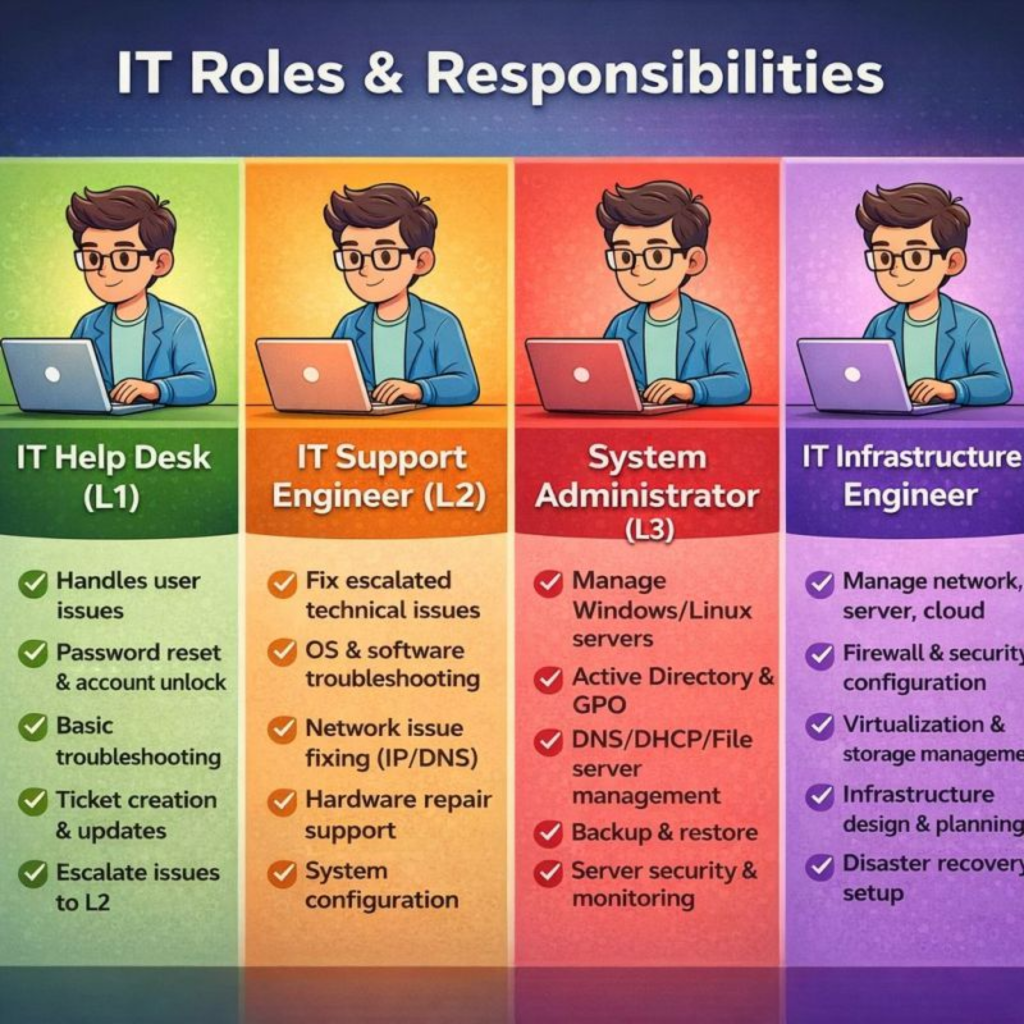
1️⃣ IT Help Desk (L1) – The Front Line of Support
Primary Focus: User-facing support and basic issue resolution.
The IT Help Desk, often referred to as Level 1 (L1), is the first point of contact for employees experiencing technical issues. Their role is critical in maintaining daily productivity.
Key Responsibilities:
-
Handling user-reported issues
-
Password resets and account unlocks
-
Basic troubleshooting (software, connectivity, devices)
-
Ticket creation, documentation, and updates
-
Escalating unresolved issues to L2 support
Skills Required:
-
Strong communication skills
-
Basic understanding of operating systems and applications
-
Customer service mindset
-
Familiarity with ticketing systems (e.g., ServiceNow, Jira)
L1 ensures quick resolution of simple problems and filters more complex issues to higher levels.
2️⃣ IT Support Engineer (L2) – Technical Problem Solver
Primary Focus: Advanced troubleshooting and issue resolution.
Level 2 (L2) support handles escalated technical problems that require deeper knowledge and hands-on expertise.
Key Responsibilities:
-
Resolving escalated technical issues
-
OS and software troubleshooting
-
Diagnosing and fixing network issues (IP, DNS)
-
Hardware repair support
-
System configuration
Skills Required:
-
Strong knowledge of Windows/macOS/Linux
-
Networking fundamentals (TCP/IP, DNS, DHCP)
-
Analytical troubleshooting skills
-
Experience with system configuration
L2 bridges the gap between user-level support and infrastructure-level administration.
3️⃣ System Administrator (L3) – Server & Core System Management
Primary Focus: Server administration and enterprise systems management.
System Administrators (Level 3 or L3) manage the organization’s core IT systems and ensure infrastructure stability.
Key Responsibilities:
-
Managing Windows/Linux servers
-
Active Directory & Group Policy (GPO)
-
DNS, DHCP, and file server management
-
Backup and restore processes
-
Server security and monitoring
Skills Required:
-
Advanced server administration
-
Scripting (PowerShell, Bash)
-
Backup solutions knowledge
-
Security hardening practices
-
Monitoring tools (e.g., Nagios, Zabbix)
L3 ensures that backend systems operate reliably and securely.
4️⃣ IT Infrastructure Engineer – Strategic Infrastructure Architect
Primary Focus: Design, implementation, and optimization of IT infrastructure.
Infrastructure Engineers operate at a strategic level. They design and maintain networks, servers, cloud environments, and disaster recovery systems.
Key Responsibilities:
-
Managing network, server, and cloud infrastructure
-
Firewall and security configuration
-
Virtualization and storage management
-
Infrastructure design and planning
-
Disaster recovery setup
Skills Required:
-
Advanced networking (routing, switching, firewalls)
-
Cloud platforms (Azure, AWS, GCP)
-
Virtualization technologies (VMware, Hyper-V)
-
Storage systems and backup architecture
-
Infrastructure as Code (Terraform, Ansible)
This role combines deep technical expertise with long-term planning and architecture.
How These Roles Work Together
IT operations function like a tiered ecosystem:
-
L1 handles volume and simple requests.
-
L2 solves more technical problems.
-
L3 manages servers and core services.
-
Infrastructure Engineers design and optimize the overall environment.
This layered approach:
-
Reduces downtime
-
Improves response times
-
Enhances security
-
Ensures scalability
Career Path in IT Support & Infrastructure
Many IT professionals begin in L1 roles and gradually move up:
Help Desk → IT Support Engineer → System Administrator → Infrastructure Engineer → Architect / IT Manager
Each step requires deeper technical knowledge, stronger troubleshooting skills, and broader system understanding.
Final Thoughts
A structured IT support model ensures efficient operations and clear responsibility boundaries. Whether you’re starting in Help Desk or aiming to become an Infrastructure Engineer, understanding these roles helps you plan your growth path strategically.
If you’re building your IT career, ask yourself:
-
Do you enjoy solving user problems?
-
Do you prefer deep technical troubleshooting?
-
Are you interested in designing entire systems?
Your answers will guide your journey through the IT ladder.
-